
July 23, 2026
Read Time ·
5 min
The Connecticut Division of Public Defender Services operates as a unified statewide system, combining local representation with specialized expertise and resources available across Connecticut. With dedicated trial offices and specialized defense units, the Division has a longstanding commitment to holistic advocacy.
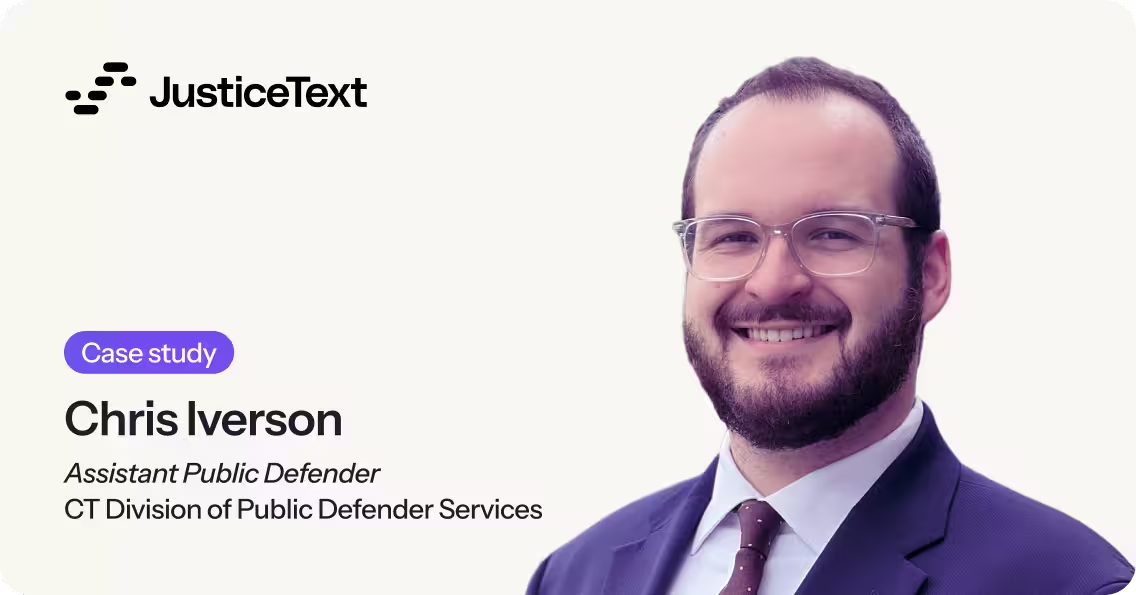
Attorney Christopher (Chris) Iverson joined the Meriden office of the Connecticut Division of Public Defender Services after graduating from law school at Quinnipiac University in 2022. He used JusticeText for his first trial in 2025, which was a complex case with hours of police body-worn camera footage and conflicting accounts of what happened during a welfare check.
Chris became a public defender because he wanted to help people in real and immediate ways. “I wanted to do something that I thought mattered,” he said.
“There are a lot of ways that a person could use a law degree to make a big difference in someone's life... The responsibility that comes with the title enables me to do things for people very quickly that make huge differences in their lives.”
For Chris’s first trial, his client was charged with interfering with the police and disorderly conduct after officers came to perform a welfare check. The encounter involved at least thirteen officers with more than eight hours of body-worn camera footage.
Reviewing that much body-worn camera footage from so many different perspectives over such a long period of time was exhausting. Chris had already worked several weekends on this case, and was feeling burned out, but he knew his client felt very strongly that the video exonerated him, and that preparing for trial meant reviewing every second of the video evidence.
That is when Chris started using JusticeText.
Chris used JusticeText’s transcript search to find exact moments without watching the videos again and found that the footage contained important details about what officers said during the encounter.
“I could just hit a keyword, and then there it is in the video. I didn’t have to watch the whole video again to find that specific moment when these two people are talking about this specific thing.”
Chris shared that video review which would have taken days was finished in less than one with JusticeText.
For part of the encounter, Chris was missing the body-worn camera footage of one officer who was particularly important to the case. He could only hear that officer secondhand, through the body cam of other officers.
JusticeText’s Multicam Sync feature let him sync multiple officers’ body-worn camera footage together in one seamless view, allowing Chris to follow that officer’s position across the other cameras until he eventually obtained the missing footage.
“I used [Multicam Sync] to track where that person was among the groups of police officers to get a better sense of what they were saying at any given point in time… that saved me.”
After uploading and reviewing the most relevant recordings in JusticeText, Chris focused on two officers whose cameras captured the most important exchanges. Once he uploaded those videos he watched the video alongside the transcript and clipped out important quotes.
“If I didn’t have the clip function, I probably would have had to learn how to use iMovie on my personal MacBook, which I really would not have wanted to do. It took me less than a day to do everything that I needed to do with the videos.”
He created clips with and without subtitles, capturing a precise statement or exchange. “Each clip was a specific quote of something that was said,” Chris explained.
“I incorporated probably 15 clips. And if I had to do this in a different, more manual, more time-consuming way, maybe I would have settled for just five.”
Before using JusticeText, he would have had to locate the right moment in a long video, show it on his laptop, and ask the witness to watch it with headphones. With the clips prepared in JusticeText in advance, he could show a ten-second segment to the jury instead of a ninety-minute video. The clips also changed how he handled cross-examination. When a witness claimed not to remember what they'd said, he could pull up the exact moment on the spot rather than hunting through a full recording in front of the jury.
Chris used clips from JusticeText for his closing defense, centered on what the officers said throughout the night. Every thirty minutes or so, and officer had told the client he wasn't in any trouble and that everything was fine.
He used his clips to continually show those reassurances across the hours of footage. “When you’re watching it on a video and you’re hearing it for yourself, that’s not really something you could ignore,” he said. "When I delivered my closing statement, I presented a timeline to show the jurors exactly what was said to my client and when."
The result was a full acquittal for his client. The jury found his client not guilty on the interference charge, and the court had already granted a motion for judgment of acquittal on disorderly conduct. The jury deliberated for only two hours.

Chris Iverson
Assistant Public Defender
